Selection Guide
Point Level Switch vs Continuous Level Transmitter: Which Do You Need?
Point level switches vs continuous level transmitters: how to choose for silos, tanks and alarm safety, and get a free quote from WELK.
Point level switches vs continuous level transmitters: how to choose for silos, tanks and alarm safety, and get a free quote from WELK.
Every tank, silo, and hopper in your plant answers one of two questions. A point level switch answers "is the material at this level or not?" — a binary, on/off signal triggered at a single setpoint, typically delivered as a relay contact. A continuous level transmitter answers "how much material is in the vessel right now?" — a proportional 4-20 mA (or HART, Modbus, or fieldbus) signal that tracks the level across the full measuring range, usually from empty to full. Point switches are fast, rugged, and cheap enough to install one per alarm point, with typical tuning fork response times of 1–3 seconds and SIL-rated versions certified for overfill protection. Continuous transmitters cost more but turn level into live data you can log, totalize, and feed into control loops. Most well-designed plants end up using both — the right answer depends on what you are trying to protect, measure, and control.
This guide compares the two approaches technology by technology, covers solids and liquids separately, and ends with a practical rule of thumb so you can decide with confidence.
The distinction sounds simple, but it drives every downstream decision — instrument selection, wiring, PLC programming, and budget.
A point level switch is a discrete sensor. It monitors one specific level — say, "high" or "low" — and changes its output state when material reaches that point. You learn one fact: the level is above the setpoint, or below it. You do not learn how far above or below, and you cannot calculate volume or mass from its signal.
Point switches are prized for three reasons. First, reliability: a mechanical or vibrating element either sees material or it does not, with no empty-scale or range calibration to drift. Second, speed: a vibrating tuning fork or paddle responds in seconds, which is why they carry the high-level alarm duty on most storage vessels. Third, cost: a point switch is typically a fraction of the price of a transmitter, so you can afford to protect every vessel with high- and low-level alarms.
A continuous level transmitter measures level across the entire range and outputs a signal proportional to it. With a 4-20 mA loop, 4 mA usually represents empty and 20 mA represents full (or your configured span). Feed that into a PLC, DCS, or SCADA system and you can:
The trade-off is that transmitters need more care — antenna position, empty-scale/range configuration, and compensation for dielectric constant, density, or vapor — and they cost more per point.
| Point Level Switch | Continuous Level Transmitter |
|---|---|
| Output signal: on/off relay contact (or NAMUR/PNP); e.g. low/high alarm | Output signal: proportional 4-20 mA; HART; Modbus; or fieldbus |
| What you learn: level is above or below one setpoint | What you learn: exact level at any moment across the range |
| Typical cost class: low–mid; cheap enough to install several per vessel | Typical cost class: mid–high per point; plus commissioning effort |
| Maintenance: minimal; no calibration under normal service; periodic function check | Maintenance: needs empty-scale/range setup and periodic verification of accuracy |
| Best for: overfill and empty-tank protection; pump control; blockage detection | Best for: inventory; custody transfer; control loops; trend logging |
| Examples: tuning fork; rotary paddle; RF admittance; vibrating rod; float switch | Examples: radar; ultrasonic; hydrostatic; magnetic float transmitter |
Point switches are the workhorses of plant safety. If your application is "keep it from overflowing" or "don't let the pump run dry," you want a switch.
Two jobs dominate point-level duty. High-level alarms (overfill protection) and low-level alarms (empty-tank and pump-protection). A low-level switch on the suction side of a pump can cut power before the pump cavitates or runs dry, preventing mechanical damage. A high-level switch on a storage tank trips an alarm or closes an inlet valve before material reaches the overflow line.
Because these are safety functions, operators often choose switches with fail-safe behavior and, where the risk justifies it, SIL-rated (Safety Integrity Level) certification for overfill protection. Tuning fork switches are the most common choice because they have no moving parts, are unaffected by flow, turbulence, foam, or changing dielectric constants, and can be self-checked.
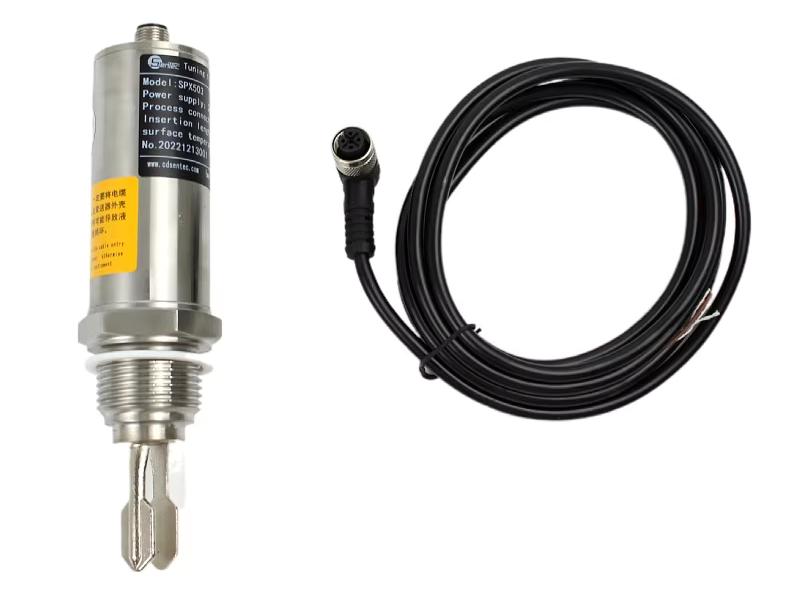
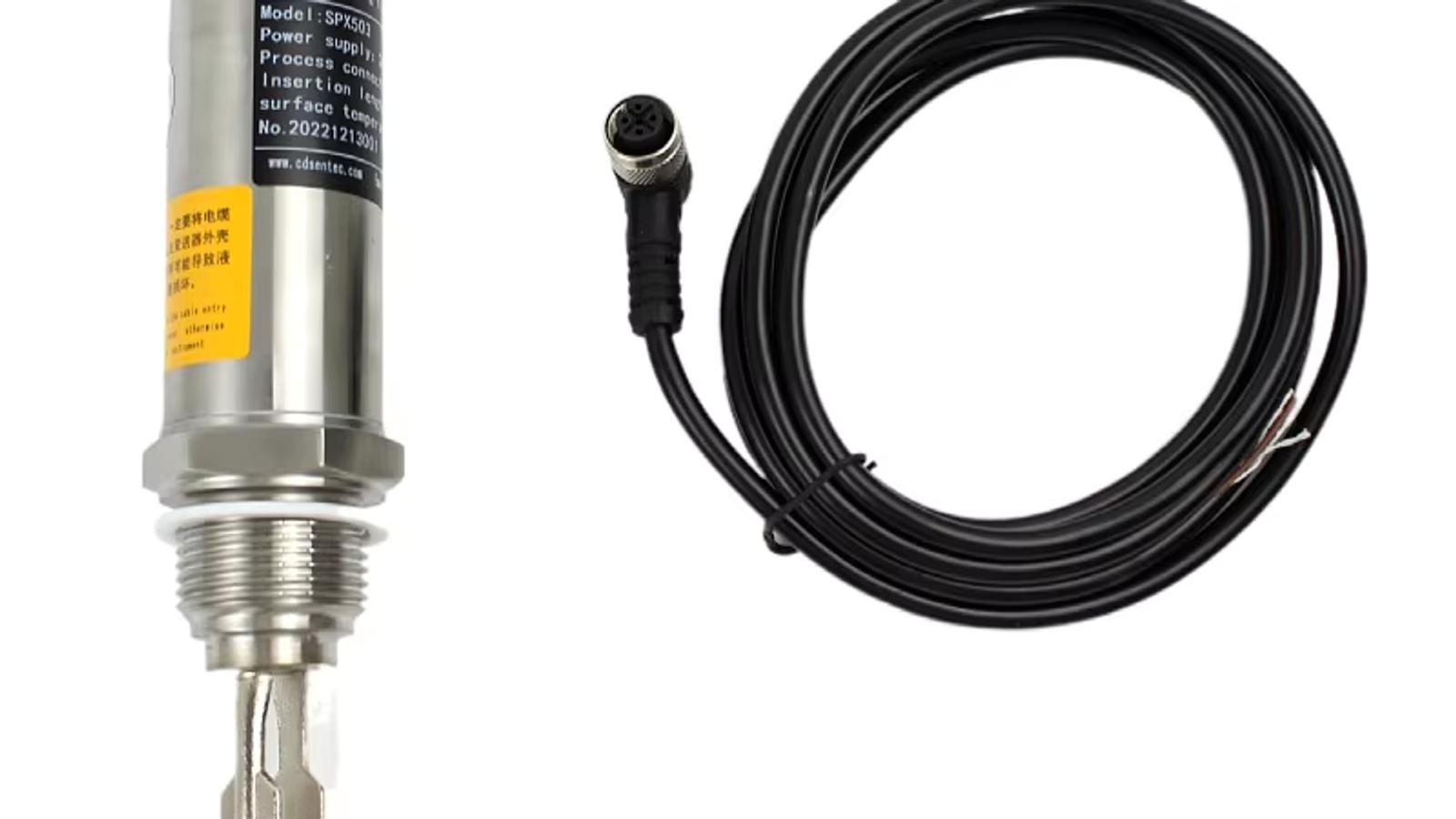
A tuning fork level switch vibrates a pair of prongs at their natural resonant frequency. When material covers the prongs, the frequency drops and the output changes state. Because there are no moving parts to wear and the fork only needs to be free of a thin layer of material, it works on liquids, slurries, and powders alike, and it ignores buildup better than many alternatives. Response is typically 1–3 seconds, and versions with extended forks can be inserted through a nozzle. We also offer a compact tuning fork level switch for installations where flange or nozzle space is tight.
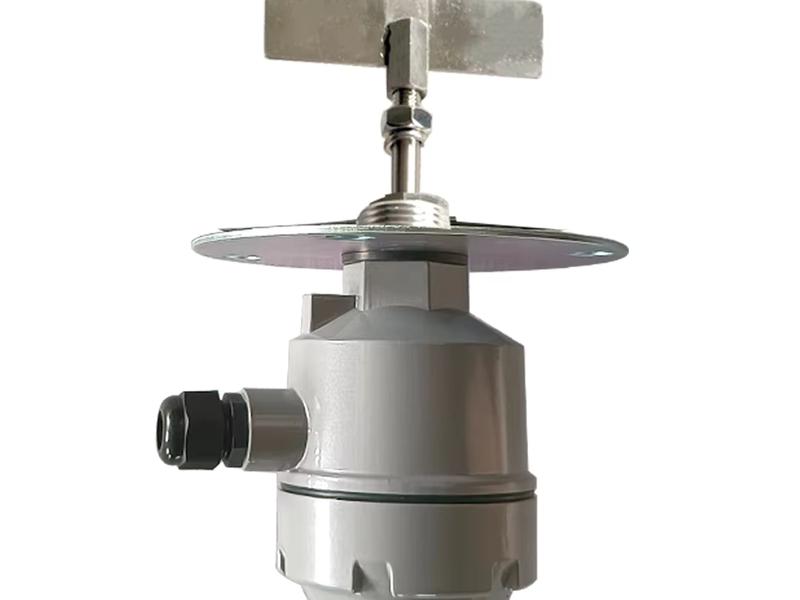
A rotary paddle level switch uses a slowly rotating paddle. When bulk solids bury the paddle, rotation stalls, a torque clutch trips, and the output switches. It is simple, proven, and widely used on cement, grain, plastic pellets, and feed. The main trade-off is mechanical: the paddle must be kept clear of heavy buildup and the shaft seal must be maintained, which matters in dusty or abrasive service.
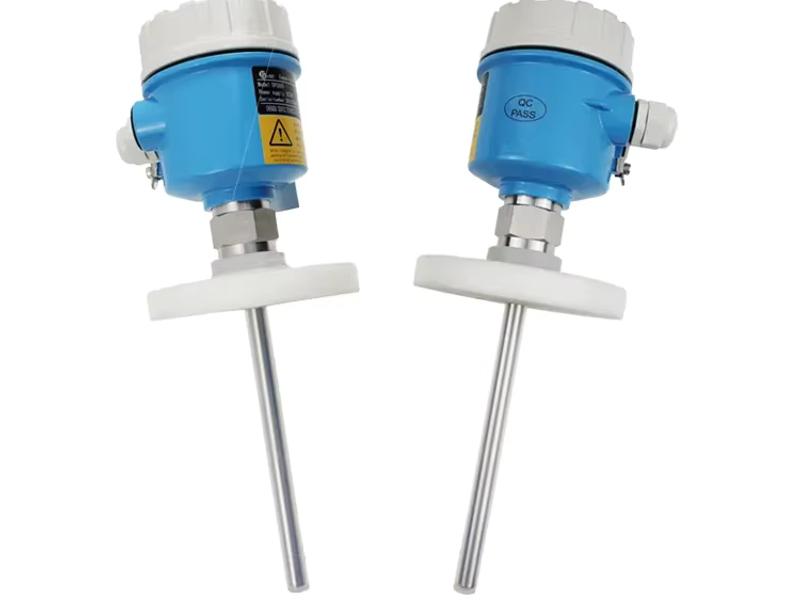
An RF admittance level switch measures the capacitance change when material contacts a probe, but with an active guard technology that cancels the effect of buildup on the probe. That makes it a strong choice for conductive liquids, sludge, interfaces, and sticky materials where a bare capacitance probe would drift. It works in high-pressure and high-temperature service, including interface detection between two liquids.
Vibrating rod switches are the solids analog of the tuning fork: a rod oscillates in free air and is damped when material surrounds it, making it excellent for powders, granules, and dusty environments where a rotating paddle might jam. Float switches — a magnetic float riding on the liquid surface that triggers a reed switch in a stem — are the oldest and cheapest option for liquid high/low alarms and are still sensible for water and simple chemical service. Float switches are simple but have more moving parts and are more sensitive to turbulence and buildup than tuning fork or RF options.
If you need to know the level at any moment — not just at alarm points — you need a continuous transmitter.
Continuous level is the backbone of inventory management. Multiplying the measured level by the vessel's geometry gives volume; multiplying by density gives mass, which lets you track stock, plan replenishment, and reconcile against deliveries. In custody transfer and billing applications, the accuracy and repeatability of the transmitter matters directly to the bottom line.
Continuous signals also enable control. Instead of a pump that switches on at low and off at high, a transmitter lets you modulate flow, hold a constant level, blend, or dose proportionally. If your process runs closed-loop level control, a proportional signal is mandatory.
Radar is the current default for continuous level. An 80 GHz radar level meter emits a focused FMCW microwave beam and measures the reflected signal. The 80 GHz band gives a narrow beam angle, which means it works well in small nozzles, with internal obstructions, and on tanks with limited free space. Radar is essentially unaffected by temperature, pressure, dust, vapor, and foam (compared with ultrasonic), and it handles both liquids and solids, including silos with heavy dust. It does need a minimum dielectric constant in the process material, which is rarely a problem in practice. For a deeper look at where radar wins over ultrasonic, see our radar vs ultrasonic comparison.
Ultrasonic transmitters measure the time of flight of a sound pulse reflected off the material surface. They are non-contact, inexpensive relative to radar, and easy to install, which makes them popular for water, wastewater, and open channels. The catch is that sound speed changes with air temperature and is disrupted by vapor, condensation, dust, and heavy foam, so accuracy can drift in harsh service. Ultrasonic is a good value in benign indoor applications; for dusty silos or volatile tanks, radar is usually the safer bet.
A hydrostatic (pressure) transmitter infers level from the liquid pressure at the bottom of the tank, which equals the liquid height times density. It is simple, low-cost, and excellent for open tanks, sumps, and reservoirs — especially a submersible hydrostatic level transmitter lowered into a well, sump, or open channel. The main limitation is that it measures head, not level: if liquid density changes, the inferred level changes even if the height is constant, so it is best for stable liquids.
A magnetic level gauge uses a float with internal magnets that move an external indicator — often a colored flag display — along the chamber, giving continuous local level indication without power. Adding a reed-chain transmitter on the chamber converts it to a continuous 4-20 mA signal for remote monitoring. This combination is valued in steam drums, chemical vessels, and applications where operators want a visible reading and a signal from the same instrument. Because the float must move freely, it suits clean liquids and is less ideal for viscous or heavily crystallizing media.
The decision matrix shifts depending on whether you store liquids or bulk solids.
If your application is a silo of powder, granules, or pellets, start with our silo and powder level application page — it covers high-level alarms, low-level alarms, and continuous inventory for bulk solids, which is where point switches and transmitters are most often combined.
The strongest installations use a continuous transmitter for the "how much" and a point switch for the "stop." Consider a fuel tank:
This layered approach is exactly what safety standards encourage: the continuous instrument handles normal operation, and the dedicated switch provides an independent protection layer. In SIL-rated overfill applications, the switch (and its wiring and logic) is kept electrically and functionally separate from the measurement loop. The same logic applies on the low side — a transmitter reports suction pressure trends while a low-level switch protects the pump.
Buying both does not mean doubling cost. Switches are inexpensive, and for a large vessel the price of one switch is trivial compared with the cost of an overflow, a damaged pump, or a lost batch.
A level switch gives an on/off signal at one setpoint (high or low alarm). A level transmitter gives a continuous proportional signal, such as 4-20 mA, that represents the level across the full range.
Neither is universally better. Use point switches for alarms, pump protection, and overfill safety; use continuous transmitters for inventory, custody transfer, and control loops. Many plants use both on the same vessel.
Tuning fork, vibrating rod, and rotary paddle switches are the most reliable for bulk solids. For dusty silos, tuning fork and vibrating rod designs avoid the moving parts that can jam on buildup.
An 80 GHz radar level meter is the strongest choice for dusty solids because microwave signals are not blocked by dust, and the narrow beam fits small nozzles and avoids internal obstructions.
You can use a transmitter's software limit alarms for basic high/low warnings, but for true overfill protection a dedicated point switch with fail-safe, independent wiring (and SIL rating where required) is the recommended practice.
There is no single "best" level instrument — only the right one for your vessel, your medium, and the job you need it to do. That is why WELK's engineers recommend starting with a short description of your application rather than a part number. Tell us the vessel type and size (tank, silo, or hopper), the medium (liquid, slurry, powder, or pellets), the measuring range, the process pressure and temperature, and the power supply or output signal you prefer. Describe whether you need a high or low alarm, continuous inventory, or both. In return, we will recommend a point level switch, a continuous level transmitter, or a combined package — sized, configured, and quoted for your site. Get a free quote from WELK by sending your tank or silo details to our engineers, or browse the instruments above to compare options first. With decades of level measurement manufacturing experience and a full factory behind us, we build the instrument to fit your process — not the other way around.
Vibrating fork point level switch for liquid overfill, dry-run protection and process interlock duty.
Electromechanical point level switch for dry bulk solids in bins, hoppers and silos.
RF admittance point level switch for sticky liquids, powders, slurries and buildup-prone applications.
Send drawings, dimensions, material, environment or operating conditions, and we will help confirm the right specification.
Uploaded reference files are included with the inquiry. For larger CAD packages, reply to the confirmation email or send them here:
Our team typically replies within 24 hours.