Boiler drum level measurement is the continuous measurement and control of the water level inside a boiler's steam drum — the pressure vessel where feedwater is converted to saturated steam and where the water/steam interface defines the boundary between the boiler, feedwater, and steam systems. The level must be held inside a narrow operating band, typically about ±50 mm (±2 in) around the drum centerline, because both extremes are destructive: low water exposes the generating tubes to overheating and is the leading cause of boiler damage, while high water carries moisture and dissolved solids over into the superheater and steam turbine. A drum level instrument is therefore a safety-critical device, normally wired into boiler control and trip logic through a standard 4–20 mA loop output with HART or fieldbus digital communication; high-end smart transmitters offer reference accuracies around ±0.075% of calibrated span.
Why Boiler Drum Level Measurement Is Critical
When drum level falls below the safe minimum, the tubes at the top of the furnace are no longer covered by boiling water and stop receiving cooling. Metal temperature climbs rapidly, tube metal creeps, distends, and finally ruptures — a failure that can drain a boiler of water in seconds and, in the worst case, produce a steam explosion. Low water is not a rare event. The National Board of Boiler and Pressure Vessel Inspectors has reported for decades that low-water conditions are the leading cause of boiler accidents; in one widely cited incident summary, more than 1,300 reported boiler accidents in a single year resulted from low-water cutoff device failure alone — nearly double the second-place category. Significantly, most of those incidents were not caused by the instrument reading incorrectly, but by level instrumentation and protective devices that were not maintained and failed exactly when they were needed.
High level is dangerous in a different way. As the water surface rises toward the steam take-off nozzles, the internal cyclones and scrubbers are flooded and carryover begins. Boiling water carrying dissolved solids is entrained into the superheater, where the droplets flash and leave hard scale on tube walls; any water that reaches the steam turbine causes erosion, thermal shock, and possible blade damage. The drum level controller is balancing two failure modes, which is why the variable is almost always automated with feedwater control (single-, two-, or three-element strategies) and why redundant level transmitters are typically voted into the safety trip logic.
What Makes a Steam Drum Difficult to Measure
A steam drum is one of the most demanding level applications in a plant, and the reasons all trace back to the physics of saturated water:
- Pressure and temperature. Drums operate anywhere from a few bar on packaged boilers up to 180 bar or more on utility boilers, with saturation temperatures from roughly 160 °C to 350 °C. Any instrument must survive both the process temperature and the thermal transients of load changes.
- Density changes. Saturated liquid density falls steeply as pressure rises: roughly 958 kg/m³ at atmospheric pressure, about 688 kg/m³ at 100 bar, and around 425 kg/m³ at 200 bar. Any instrument that infers level from hydrostatic head must know the current density, or its reading drifts as operating pressure changes.
- Swell and shrink. When steam demand rises, drum pressure drops slightly and a fraction of the saturated water flashes to steam, expanding the water/steam mixture. Apparent level rises even though the mass of water in the drum is unchanged; the reverse happens on load reduction. The instrument sees a noisy, moving surface on top of violent boiling.
- Steam, condensation, and impulse lines. Pressure connections and impulse lines on a steam drum contain steam that condenses, so reference legs and seals must be designed and maintained carefully to hold a constant head.
- Limited nozzles. The drum has a fixed set of nozzles and geometry; the measurement must fit what the vessel actually provides.
For all these reasons, no single technology is perfect — and plant experience shows that a well-chosen combination, rather than one "best" instrument, is the most reliable answer.
Three Technologies Compared
| Feature | DP transmitter | Guided wave radar | Magnetic level gauge |
|---|
| Measuring principle | Hydrostatic head difference between two drum taps (wet leg or remote seal) | Microwave pulse travels down a probe and reflects off the water surface (time of flight) | Float inside a chamber couples magnetically to an external indicator |
| Accuracy | Reference accuracy ±0.075% to ±0.5% of calibrated span; overall drum accuracy usually dominated by density and wet-leg errors | ±3–10 mm in a stilling-well installation | Visual indication ±5–10 mm; magnetostrictive version down to ±1–2 mm |
| Steam/water density dependence | High — needs density compensation | Low — measures the physical surface; not hydrostatic head | Low — the float follows the actual interface |
| Response time | Fast (milliseconds; with adjustable damping) | Fast (sub-second update; configurable) | Slow — limited by float mechanics and indicator |
| Maintenance | High — impulse lines; wet leg; seals; blowdown; periodic calibration | Low to moderate — probe fouling; electronics checks | Moderate — chamber cleaning; float inspection; gasket renewal |
| Typical cost class | Medium | Higher initial cost (radar electronics plus high-temperature probe) | Lowest initial; rises with pressure rating and steam jacket |
| Best for | Standard control and trip duty on high-pressure drums; the proven industry workhorse | Direct level measurement where density compensation is hard; or where impulse lines are problematic | Local visual indication and backup to electronic instruments; including cold-climate service with a steam jacket |
Differential Pressure Transmitters — The Proven Standard
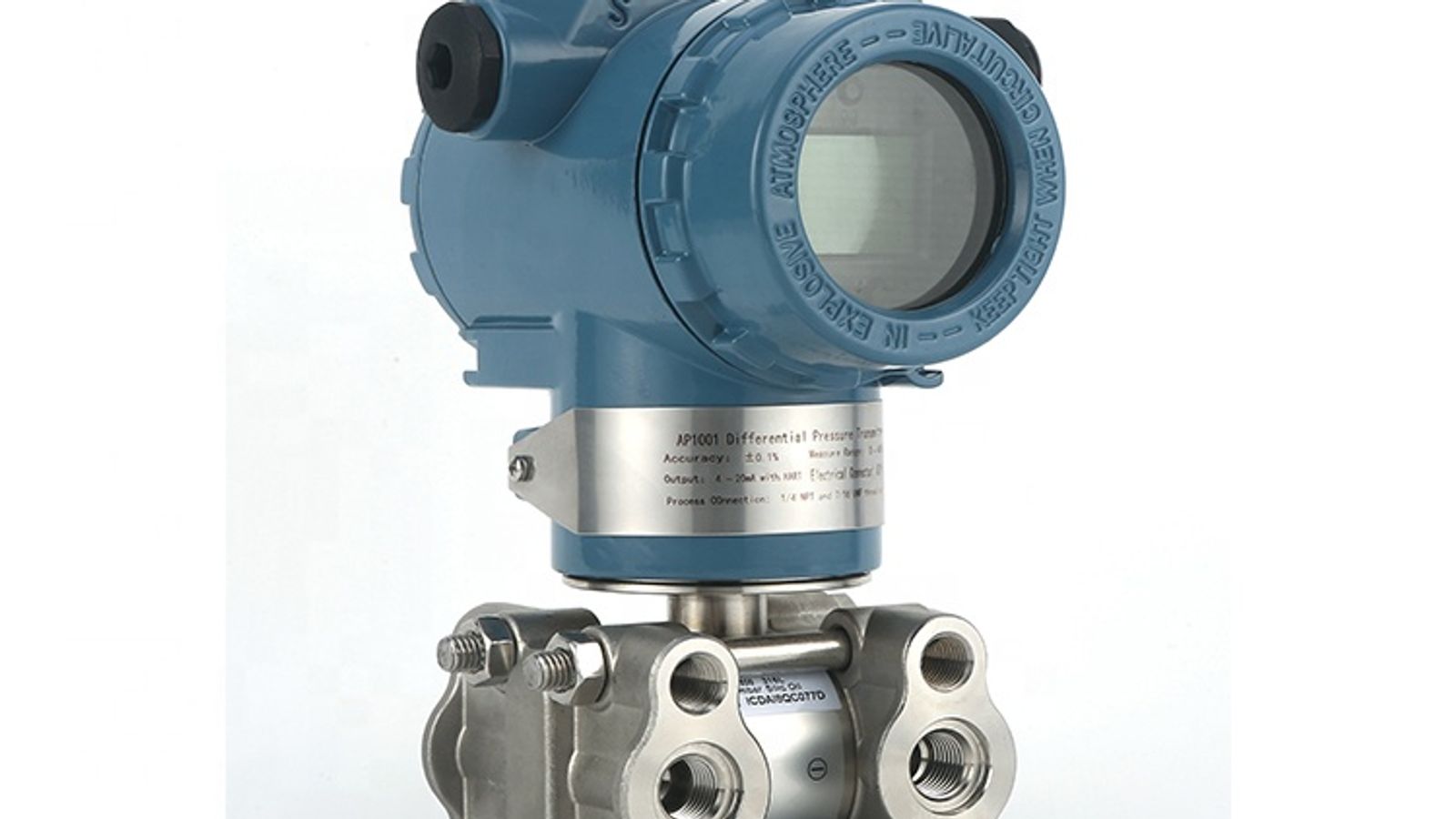
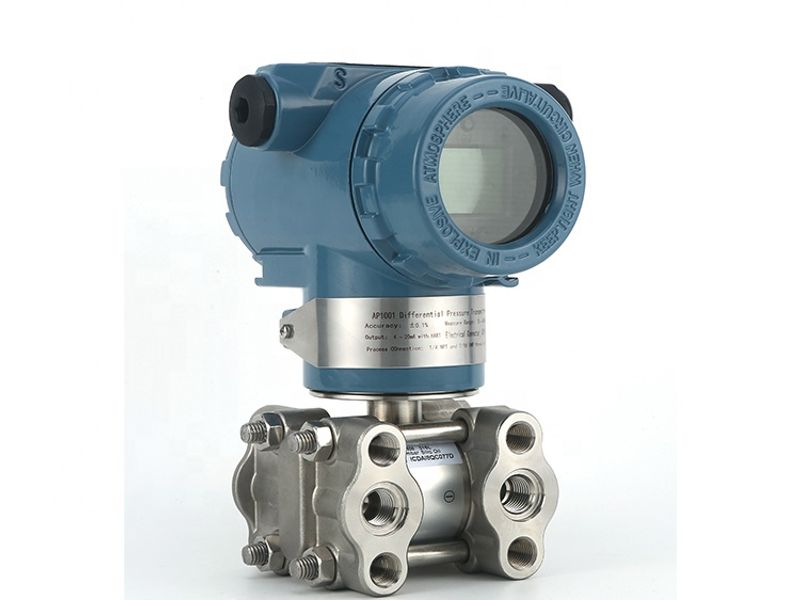
The differential pressure (DP) level transmitter is the traditional and still most widely used drum level instrument. It works by measuring the difference in hydrostatic pressure between two connections on the drum — one near the normal water level (the "low-side" reference) and one lower down or at the drum bottom. The pressure difference is proportional to the height of the water column, and a 4–20 mA signal proportional to level is sent to the DCS, boiler control system, and trip logic.
Wet legs and remote seals. On a steam drum, the reference connection is almost always a wet leg: a vertical impulse line intentionally filled with condensate and kept at a constant, known height. The transmitter then sees only the change in head caused by the water level. Because the wet leg is the reference, its height and density must stay constant, which is why wet legs need a condensate pot and periodic attention. Where impulse lines are impractical or freezing is a concern, remote (diaphragm) seals flange directly onto the drum nozzles and transmit pressure through capillary tubes filled with fill fluid — eliminating impulse-line freezing at some cost in accuracy from capillary fill-fluid effects. Our differential pressure level transmitters cover the wet-leg and remote-seal configurations used on boiler drums.
Density compensation. The fundamental weakness of a DP transmitter on a drum is that it measures head, not level, and head depends on density. Because saturated water density changes with pressure, good practice is to compensate online: the transmitter or the DCS calculates level from the measured differential pressure and the water/steam densities drawn from steam tables at the live drum pressure. With compensation, a high-end smart transmitter with a reference accuracy of ±0.075% of span delivers control-grade performance; without it, a significant pressure swing can shift the indicated level by a large fraction of the drum span.
Strengths and weaknesses. DP transmitters are proven, fast, robust, and understood by every instrument technician. Their weaknesses are the wet leg and impulse-line system (freezing, plugging, density drift), the need for density compensation, and the fact that the measurement is indirect. Still, on high-pressure steam drums, the DP transmitter remains the default choice for the control loop — and the technology against which everything else is measured.
Guided Wave Radar — Direct Measurement in the Vapor Space
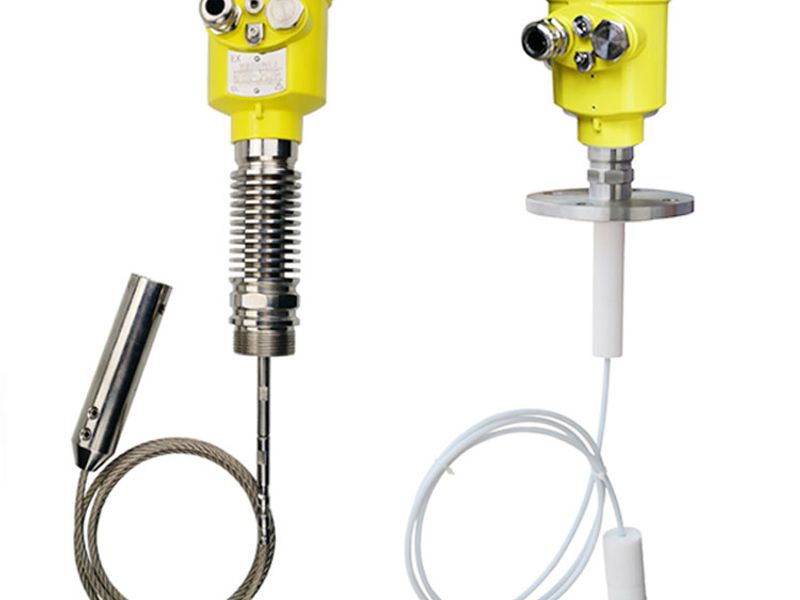
Guided wave radar (GWR) measures level directly rather than inferring it. A low-energy microwave pulse is launched down a probe extending into the drum; when the pulse reaches the water surface it reflects back because of the large difference in dielectric constant between steam vapor (close to 1) and liquid water (much higher, even at operating temperature). Time of flight is converted into a distance, and level is the probe length minus that distance.
For steam drum service, GWR has two big attractions. First, it is essentially independent of density: it measures the physical position of the water surface, so changes in saturated water density with pressure introduce almost no error — there is no wet leg and no density compensation to get wrong. Second, it needs no impulse lines, which removes the classic freezing, plugging, and condensation problems of a DP installation and makes retrofit much simpler.
The challenges on a drum are equally real. The surface inside a boiling drum is violent, so GWR is normally installed in a stilling well or bypass chamber to provide a calm measuring surface — standard practice that delivers the ±3–10 mm accuracy quoted in the table. High-pressure, high-temperature probe versions are required for utility drums, and condensation or foam on the probe can weaken the reflection, so probe selection, length, and installation position matter. Our cable-guided wave radar level transmitter is suited to high-temperature, high-pressure services where a clean, direct level measurement is preferred.
GWR is not automatically "better" than a DP transmitter on a drum — many plants run both, using the DP unit for the control loop and a GWR as an independent, density-immune trip and reference measurement. Where the two differ most is in failure mode: DP fails on density and impulse-line integrity; GWR fails on probe and vapor-space conditions. A redundant combination gives you the best of both.
Magnetic Level Gauges — Local Visual Indication
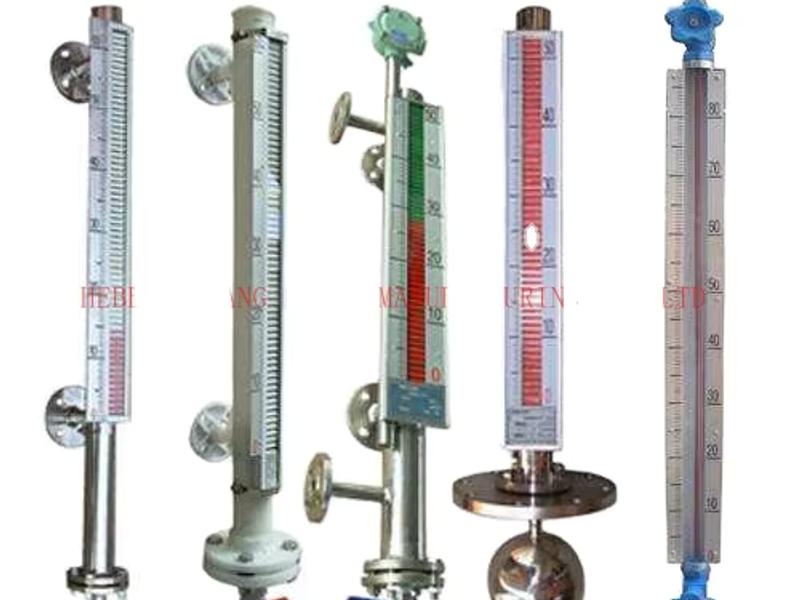
A magnetic level gauge is the simplest of the three: a float inside a vertical chamber rides the water surface, and its internal magnets couple to a stack of colored flags or a magnetic shuttle on the outside of the chamber, giving a continuous local visual indication with no power and no electronics. On a boiler drum it is used primarily as an operator's last line of sight — a local check that agrees with, or overrides, what the control room says — and as a low-cost backup to electronic instruments. Versions with magnetostrictive transmitters add a 4–20 mA output, and reed-switch arrays can drive alarms.
Because drums run hot and pressurized, the gauge must be built for the duty: forged-body chambers rated for the drum's pressure class, high-temperature materials, and careful gasket selection. In cold climates, a plain water column or chamber is vulnerable to freezing, which destroys both the indication and the mechanical integrity of the chamber. A steam-jacket version — a heating jacket around the chamber supplied with steam — keeps the gauge at process temperature so it reads correctly and reliably year-round. Our steam-jacket magnetic level gauge is designed for exactly this service, and the standard magnetic level gauge covers the wider range of tank and vessel applications.
The limits of a magnetic gauge are its speed and its lack of a native control signal. The float moves with the liquid, but the indicator cannot provide the fast, dense measurement a control loop needs, and a sticking float is a real, if infrequent, failure mode. That is why the magnetic gauge is almost always a complement to — not a replacement for — an electronic transmitter on a drum.
How to Choose the Right Technology
The practical answer for a high-pressure steam drum is usually a combination, and the division of labor is fairly standard across the industry:
- Control loop: a DP transmitter with density compensation is the proven default — fast, robust, and the technology every control strategy and maintenance crew already understands.
- Independent safety or reference measurement: a second DP channel or a guided wave radar in a stilling well, chosen so its failure modes differ from the control transmitter.
- Local indication: a magnetic level gauge, steam-jacketed in cold climates, gives operators an always-available visual check.
If you are retrofitting, if impulse lines are a chronic problem at your site, or if density compensation has proved unreliable, guided wave radar is the strongest alternative. If your real need is a reliable local reading for a small boiler or a secondary drum, a magnetic level gauge may be all you need. When price is the deciding factor, remember that total installed cost includes impulse lines, manifolds, blowdown piping, and calibration — not just the transmitter on the shelf. For a broader look at how these technologies fit together, our comparison of level measurement technologies and our boiler and process vessel application page cover the surrounding engineering decisions.
Installation, Safety, and Best Practices
Whichever technology you choose, a few practices separate a reliable drum level installation from a chronic problem:
- Redundancy and voting. Because drum level is safety-related, install at least two independent transmitters and, where trips are involved, vote them (commonly two-out-of-three). Instrument failure must not disable the low-water trip.
- SIL and overfill safety. Select transmitters that meet IEC 61508/61511 functional-safety requirements for the required SIL level of your burner or trip system, and document proof tests. Although the drum's headline hazard is low water, high-level alarms and trips protect against carryover and overfilling of the steam space.
- Steam jackets and heat tracing. In cold climates, trace and insulate wet legs, impulse lines, and gauge chambers. A steam-jacketed gauge or traced impulse lines prevent freezing that would stop the measurement at the worst possible time.
- Density compensation. For every DP transmitter, wire in live drum pressure and apply steam-table density compensation; audit it after pressure upsets.
- Blowdown and calibration. Wet legs and chambers collect sludge and scale. Follow a scheduled blowdown, calibrate transmitters on a regular interval, and verify the local magnetic gauge against the electronic reading.
- Signal output. A 4–20 mA HART loop is the standard interface to the DCS and safety system; if you are also considering digital buses, our guide to 4–20 mA vs HART vs Modbus/RS485 explains the trade-offs.
FAQ
What is the normal water level in a boiler steam drum? The normal water level (NWL) is normally set at or near the drum centerline, and level is typically held within about ±50 mm (±2 in) of that setpoint during steady operation.
Which is better for boiler drum level: a DP transmitter or guided wave radar? It depends on your reliability philosophy. DP transmitters are the proven standard for control and excel when density compensation is applied; guided wave radar measures the physical surface and avoids density and wet-leg errors. Many plants use one of each in a redundant arrangement.
Can a magnetic level gauge be used on a high-pressure steam drum? Yes. Forged-body magnetic level gauges are available for high pressure ratings and high temperatures, and steam-jacketed versions handle cold climates. They provide local visual indication and backup, but they are not a substitute for a fast control transmitter.
Why does a boiler drum DP level transmitter need a wet leg? The reference connection on a drum contains steam, which would make the reference head unpredictable. A wet leg filled with condensate holds a constant reference column, so the differential pressure reading becomes a true measure of water level.
Is density compensation necessary for boiler drum level measurement? For DP transmitters, yes. Saturated water density changes significantly with pressure, so compensating with steam tables at live drum pressure is what keeps the reading accurate. Guided wave radar and magnetic gauges measure the physical interface and do not need it.
Get a Selection Recommendation for Your Drum
There is no single "best" boiler drum level instrument — only the right combination for your operating pressure, drum geometry, and safety philosophy. WELK Instruments builds differential pressure transmitters, guided wave radar, and magnetic level gauges (including steam-jacketed models) under one roof, so we can recommend honestly across technologies rather than upselling a single product line. Send us your boiler specifications — operating pressure and temperature, drum dimensions and nozzle arrangement, and whether you need control, local indication, or SIL-rated trips — and our engineers will propose the right instruments with a free selection consultation and quote.