Technical
How Accurate Is an 80 GHz Radar Level Meter? Repeatability, Damping and Noise Explained
80 GHz radar level meter accuracy explained: ±2 mm repeatability, damping vs response time, noise and false echoes. Get spec sheets with accuracy data.
80 GHz radar level meter accuracy explained: ±2 mm repeatability, damping vs response time, noise and false echoes. Get spec sheets with accuracy data.
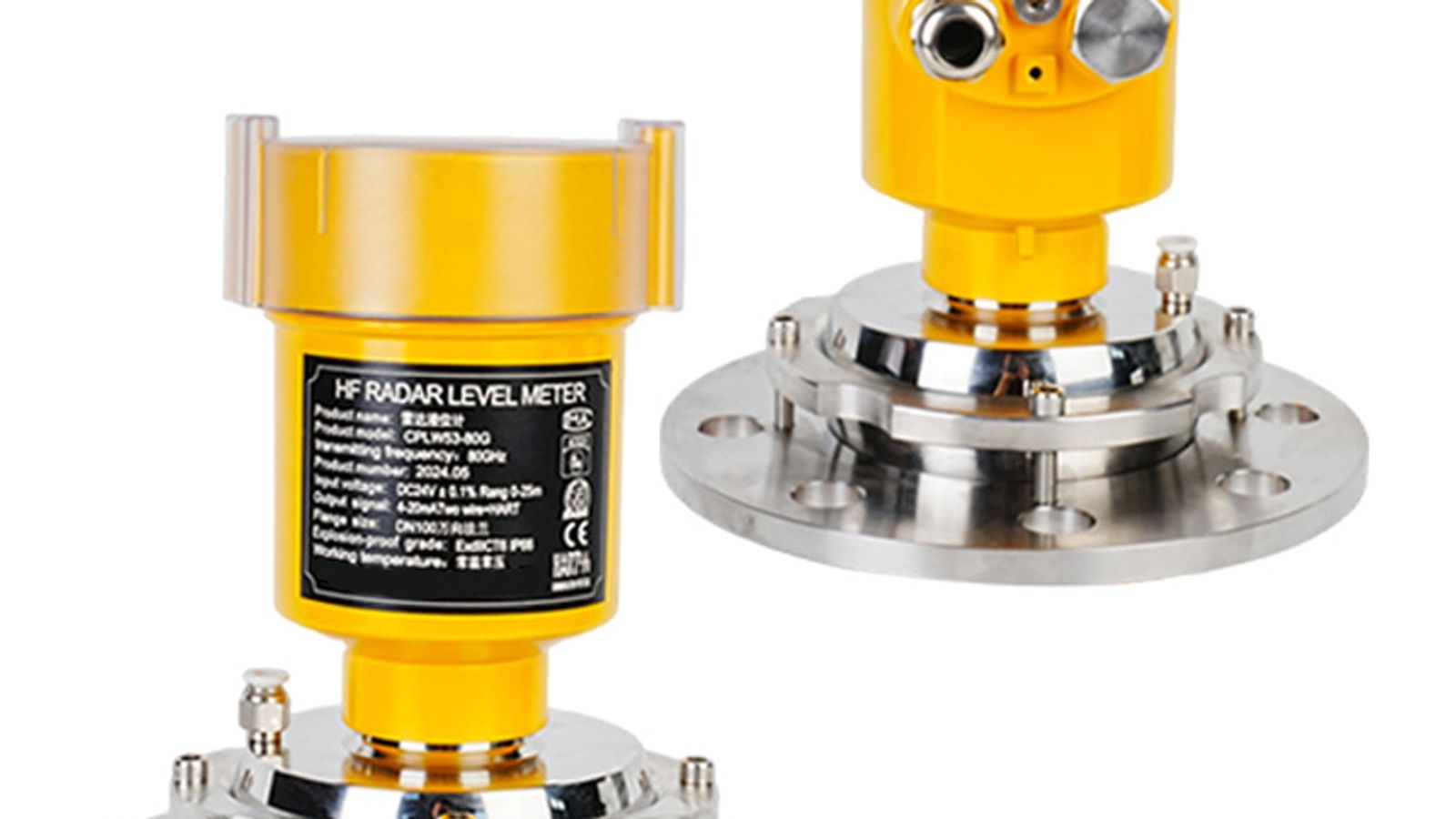
An 80 GHz radar level meter is a non-contact, frequency-modulated continuous wave (FMCW) instrument that measures the distance to a liquid or solid surface and reports the level with a typical accuracy of ±2 mm or ±0.05% of the measured range, whichever is greater, for the WELK 80 GHz series. Accuracy describes how close the reported value is to the true level, repeatability describes how consistently the meter reproduces the same reading under identical conditions (±0.1 mm), and resolution is the smallest change the instrument can detect (down to 1 mm). The value on your display is also shaped by the measurement update time, typically 1–2 seconds, and by the damping factor, which deliberately trades response speed against signal stability. Understanding the difference between these specifications is the difference between buying a level meter and buying a number that looks good on a datasheet.
This guide explains what 80 GHz radar accuracy really means in process terms: how the FMCW principle produces the measurement, why the 80 GHz band improves accuracy in narrow nozzles and small tanks, how damping and update time affect what you see, and where noise, false echoes, steam and dielectric constant can push a reading outside the published tolerance.
Three terms are routinely conflated in level measurement, and they answer three different questions:
A related term that catches buyers out is dead band: the zone near the antenna top where the instrument cannot measure. The short wavelength of 80 GHz allows a very compact antenna and a dead band of only a few centimetres from the flange, which matters in small tanks where usable height is precious. When a supplier quotes "accuracy ±2 mm", always ask which of these three they mean — the honest ones will show you accuracy, repeatability and dead band as separate lines.
An FMCW radar does not measure time-of-flight like a pulse radar. Instead, it transmits a signal whose frequency sweeps linearly with time across a wide bandwidth, typically several gigahertz inside the 80 GHz band (W-band, 76–81 GHz). The transmitted sweep is reflected from the material surface and received a fraction of a nanosecond later. Because the frequency was still ramping when the echo returned, the returning signal is at a slightly different frequency from the transmitted signal at that instant. Mixing the two produces a beat frequency that is directly proportional to the round-trip distance. The instrument converts that beat frequency into distance, subtracts it from the installation height, and reports the level.
Two properties make this approach accurate. First, the distance is derived from a frequency difference measured over the entire sweep, so it is averaged over many cycles rather than read from a single pulse edge — this is why FMCW repeatability reaches ±0.1 mm. Second, a wider sweep bandwidth produces a finer frequency resolution and therefore finer distance resolution, and the 80 GHz band allows a large sweep bandwidth in a physically small antenna.
The practical advantage of 80 GHz over lower bands is beam angle. At 26 GHz, focusing the same energy into a narrow beam requires an antenna 200–400 mm across; an 80 GHz module with a comparable aperture produces a beam of roughly 3° instead of 10–20°. In a narrow stilling well, bypass pipe or small tank, a 3° beam hits the material cleanly instead of grazing the walls, so the dominant echo is the true surface rather than a wall reflection. Less side-lobe energy also means less crosstalk from nozzles, agitators and internal structures. The result is a cleaner echo profile, fewer false echoes to suppress, and more of the published ±2 mm accuracy actually delivered in difficult geometry. If you are comparing the two bands directly, our full comparison explains the differences in detail: 80 GHz vs 26 GHz Radar Level Transmitters.
No single technology wins every installation. The table below summarises where each sits:
| Parameter | 80 GHz FMCW Radar | 26 GHz FMCW Radar | Guided Wave Radar (GWR) |
|---|---|---|---|
| Typical accuracy | ±2 mm or ±0.05% of range | ±3–5 mm | ±3 mm |
| Beam angle | ≈3° | 10–20° | None (wave travels along probe) |
| Maximum range | up to 120 m | up to 70–80 m | Limited by probe length (up to ~50 m) |
| Contact | Non-contact | Non-contact | Contact (probe in medium) |
| Narrow nozzles / stilling wells | Excellent | Good with large antenna | Excellent |
| Foam; heavy steam; condensate | Good | Good | Best (signal cannot be lost to foam) |
| Low dielectric materials | Very good (tight beam; high gain) | Moderate | Good (guided energy) |
| Agitators / internal structures | Very good (narrow beam avoids them) | Moderate | Can be damaged by agitator contact |
| Best for | Small tanks; tight nozzles; solids; long range | Large liquid tanks; general duty | Small agitated vessels; foamy media; low tanks |
The non-contact nature of 80 GHz radar is its main advantage over guided wave: no probe to foul, bend or shear off in an agitator, and no maintenance access to the vessel interior. Where foam or steam defeats a non-contact reading altogether, guided wave is the fallback, but that is a smaller set of applications than suppliers often claim. For a broader view of where each technology fits, see our level measurement technologies comparison.
Repeatability and accuracy are quoted on a clean, static surface. The real process is rarely that tidy, which is why the damping factor exists.
Damping applies a smoothing filter to the raw measurement. On a WELK 80 GHz transmitter the damping time is adjustable from 0 to 999 seconds. A low damping value keeps the output responsive: a tank that fills quickly shows the true level almost immediately, within the 1–2 second update cycle. A high damping value averages out surface turbulence, vortexing and signal flutter, so a stationary level reads dead-stable to a controller or PLC. The trade-off is the one every process engineer recognises: the more you damp, the later you see a real change. A meter damped to 60 seconds will show a genuine level drop only after the reading has been smoothed for a minute — far too slow for an alarm on a critical vessel.
The right damping is a process decision, not a default. For fast batch filling and safety-critical level alarms, keep damping at 1–5 seconds and use the 1–2 second update cycle. For custody-style inventory on a calm tank, a higher damping value removes hundreds of millimetres of apparent fluctuation. Because the damping setting is a pure software filter, it can be tuned on-site without touching the installation — but it should be recorded in the configuration so a technician does not later "fix" a stable reading that is deliberately damped.
Every radar level meter receives noise: thermal noise from the electronics, side-lobe leakage from the antenna, and above all false echoes from tank walls, nozzles, baffles, heating coils, agitator blades and structural beams. On a noisy surface the real echo may be only slightly stronger than several false ones, and this is where 80 GHz earns its accuracy claim.
Because the beam is narrow, the antenna illuminates far less of the vessel interior, so fewer structures generate false echoes in the first place. The receiver's high signal-to-noise ratio (SNR) means the true surface echo stays distinguishable even when the material's reflectivity is low. The transmitter software then applies three layers of protection: a static echo map learned during commissioning (often the first-ever echo profile is recorded as the reference), dynamic false-echo suppression that tracks and discounts echoes known to come from fixed structures, and a surface-tracking algorithm that locks onto the strongest echo in a plausibility window. If the true echo drops below the noise floor momentarily — during a violent pour, say — the meter holds the last valid value rather than jumping to a wall echo.
The practical question is how much of the published ±2 mm survives real noise. The answer is that the ±2 mm figure is a measurement accuracy under defined conditions; in heavy turbulence or with a very weak echo the reading may degrade to several millimetres of apparent scatter. That scatter is not a defect — it is physics — and it is exactly what damping and echo-map configuration are for.
Water vapour absorbs microwaves, and the effect grows with frequency, so 80 GHz does face more attenuation in dense steam than 26 GHz. In practice, modern high-dynamic-range transmitters compensate for this, and the more serious problem is usually condensation on the antenna, which can form a water film that attenuates the signal and adds a small error. Where steam and condensate are persistent, an air purge or a hydrophobic antenna coating is the standard fix — see the 80 GHz radar with air purge for the dedicated option.
Dry dust is surprisingly transparent to radar, and the 80 GHz band penetrates dusty atmospheres well, which is why it has become the default for cement, fly ash and powder silos. The real challenge with solids is the surface itself: a cone of cement powder at an angle can scatter the beam away from the antenna. The narrow 3° beam and high gain help, and a stilling plate or a carefully aimed installation resolves most cases. For powders and cement in silos, we have a dedicated application guide on silo level measurement for powders and cement.
The dielectric constant (relative permittivity, εr) of the material determines how much of the radar signal reflects. A high-εr liquid like water (≈80) returns a strong echo; low-εr materials like oils (2–4), plastics and dry powders return less. The practical threshold for reliable radar measurement is roughly εr ≥ 1.4–1.9. Above that, dielectric constant affects signal strength, not the distance calculation itself: FMCW measures frequency, not amplitude, so a weaker echo does not shift the reported level. Accuracy holds as long as the echo remains detectable. That is why a 80 GHz meter can report ±2 mm on a low-εr powder that a lower-frequency radar might not even detect reliably.
The ±2 mm figure assumes the meter knows its own installation height. Field calibration is therefore less about "adjusting the radar" and more about verifying the reference: the zero point (the antenna reference plane) and the blocking distance (empty tank / full range) settings entered at commissioning.
An 80 GHz FMCW radar is factory-characterised and does not drift like an analogue sensor, so routine recalibration is usually unnecessary. What you should do on a maintenance schedule is a zero-point verification: compare the reported level against a known reference (a dip tape or sight glass) at a stable point, and if there is a fixed offset, apply it as an offset parameter rather than "calibrating" the measurement. The transmitter supports on-site configuration through its display, HART or other digital protocol, so the zero point, damping, echo map and output scaling can all be adjusted on the tank top without opening the instrument. After a re-mount or antenna change, re-run the echo-map acquisition; the software records the new reference profile and re-learns the false echoes. For chemically aggressive environments where the electronics need to be separated from the process, the explosion-proof radar level transmitter offers the same accuracy in a certified housing.
The discipline that protects accuracy is documentation: record the installation height, the reference plane used, the damping value and the date of each zero-point check. With those four items recorded, a ±2 mm claim is verifiable on any tank in your plant.
Summarising the real-world boundaries: accuracy of ±2 mm or ±0.05% of range applies when the echo is clean and the surface is reasonably calm; repeatability of ±0.1 mm applies under identical conditions; the 1–2 second update plus your chosen damping defines how quickly the reading responds; and signal noise, false echoes, heavy steam, condensation on the antenna and extremely low dielectric constants are the factors that can push a reading wider than the datasheet. In every one of those cases the degradation is manageable — with damping, an air purge, a better mounting position or a higher-spec antenna — and the narrow beam of 80 GHz is precisely what reduces most of them before they start. The 80 GHz radar level meter product family covers compact transmitters for small vessels, long-range units to 120 m for silos, and options for high-temperature and explosion-proof service, with application guidance for chemical storage tanks and silos.
Is ±2 mm accuracy guaranteed in all conditions? No. ±2 mm or ±0.05% of range is the accuracy under defined reference conditions: a clean surface, calm medium, and correct installation and configuration. In turbulent, foamy or low-reflectivity service the reading may scatter by a few millimetres, and dense steam or condensation on the antenna adds attenuation. The ±2 mm figure is a design accuracy, not a guarantee against physics.
How does dielectric constant affect accuracy? Dielectric constant determines echo strength, not the distance calculation, because FMCW measures frequency rather than amplitude. As long as the echo remains above the detection threshold (roughly εr ≥ 1.4–1.9), the reported level is unaffected. Very low-εr materials may produce a weak or intermittent echo, which is a detection problem, not a calibration error.
How does damping affect response time? Damping applies a smoothing filter over a configurable period (0–999 s). Low damping keeps the output close to the 1–2 second update cycle; high damping stabilises a fluctuating reading but delays the response to genuine level changes, potentially by the full damping time. Set damping per process, not per habit.
Can I calibrate the meter on-site? Yes. Zero point, offset, damping, echo map and output scaling are configurable on site via the display or digital communication. Because FMCW radar does not drift like an analogue sensor, routine recalibration is unnecessary; a periodic zero-point verification against a dip tape or sight glass is the recommended maintenance.
Does foam or steam affect 80 GHz radar accuracy? Heavy steam attenuates high-frequency signals more than low-frequency ones, and condensation on the antenna can add error — the standard countermeasures are an air purge and antenna coatings. Foam behaves differently: a light, conductive foam layer may be ignored while the radar reads the liquid beneath it, but a thick, dry, low-density foam can absorb the signal and read the foam surface instead. For persistent foam, guided wave radar is the safer choice.
Accuracy specifications only mean something when you can read the full datasheet. The WELK 80 GHz radar level meter range covers compact transmitters for tight vessels, long-range silo radar to 120 m, air-purge versions for steam and condensation, and explosion-proof housings for hazardous areas. Request the specification sheets for your process conditions — including the accuracy, repeatability, dead band and damping tables for each model — and a sizing recommendation for your tank geometry, nozzle size and material. Send your application details and the WELK engineering team will confirm which configuration delivers the repeatability and response time your process needs.
Configurable 80 GHz FMCW radar level meter for storage tanks, process vessels and selected solids with narrow-beam non-contact measurement.
80 GHz radar package with purge connection for dusty silos and applications where antenna buildup can weaken the echo.
Long-range radar level meter for powders, pellets, cement, fly ash and bulk solids storage where dust and uneven surfaces must be reviewed.
Send drawings, dimensions, material, environment or operating conditions, and we will help confirm the right specification.
Uploaded reference files are included with the inquiry. For larger CAD packages, reply to the confirmation email or send them here:
Our team typically replies within 24 hours.