Technical
Tuning Fork Level Switch: How It Detects Liquids and Powders
How tuning fork level switches detect liquids and powders: resonant frequency, density limits, fail-safe wiring, and comparison vs float and paddle switches.
How tuning fork level switches detect liquids and powders: resonant frequency, density limits, fail-safe wiring, and comparison vs float and paddle switches.
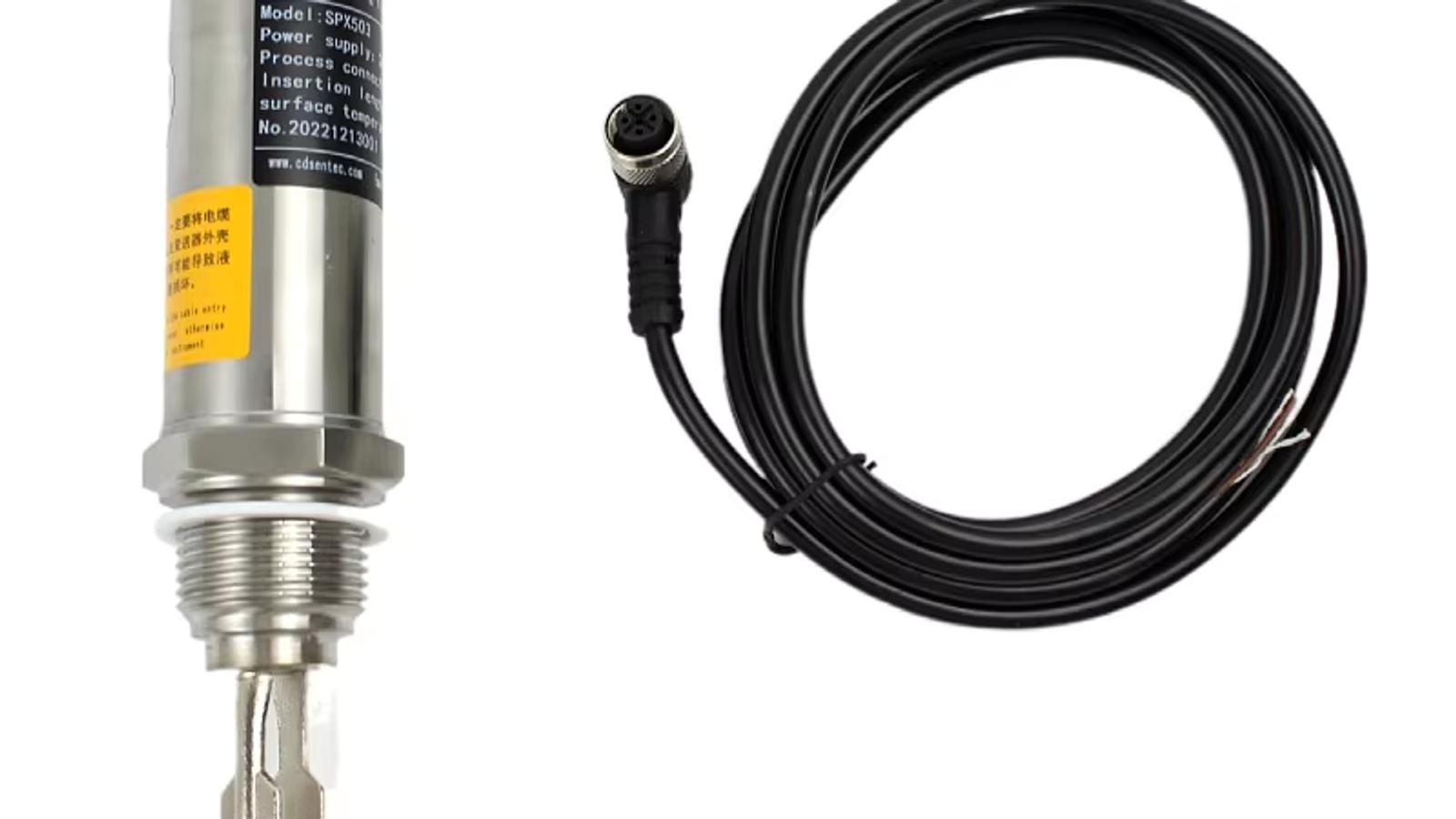
A tuning fork level switch is a point-level instrument that detects the presence of a liquid or bulk solid by continuously vibrating a fork at its resonant frequency — typically 300 to 1,400 Hz depending on fork design and tine length. When the medium covers the fork, it damps the vibration: the frequency drops and the amplitude changes, and the switch electronics compare the shifted signal against a set threshold to trip a relay output for high, low, or intermediate level alarms. Standard tuning fork level switches detect liquids with a density of 0.5–0.7 g/cm³ or higher and bulk solids with a bulk density of 20–30 g/L or higher, operate from –40°C to +150°C (up to +250°C with extended options) at pressures up to 40 bar, and can be supplied with 316L, Hastelloy, or PTFE/ECTFE-coated wetted parts. Because the same fork principle serves both fluid families with no moving parts, it is one of the most widely specified point-level technologies in process plants today.
Inside the probe housing, two piezoelectric crystals are bonded near the base of the fork. One crystal drives the fork into continuous oscillation; the other senses the vibration and feeds the signal back to the electronics. This closed-loop arrangement keeps the fork vibrating at its natural resonant frequency, which is determined by the geometry and material of the tines. When the fork is surrounded only by air, it oscillates at a well-defined characteristic frequency — the "dry" or reference state.
The detection event is triggered by a change in that oscillation. When a liquid or powder covers the fork, the medium increases the effective mass of the tines and absorbs vibrational energy. The result is a measurable downward shift in resonant frequency and a reduction in amplitude. The switch electronics continuously compare the live vibration signal against the reference threshold; once the shift exceeds the trigger point, the output relay changes state and the switch generates an alarm or control signal. When the medium falls away, the fork returns to its air reference frequency and the output resets.
Because the electronics monitor a relative change rather than an absolute measurement, the tuning fork is largely self-compensating for temperature and aging. Two fork variants are commonly offered: a frequency-shift design, well suited to most liquids and to low-density powders, and an amplitude-detection design used where the medium causes strong damping. The fork itself flexes at a microscopic amplitude — typically only a few micrometers — which is small enough that the tines operate in the purely elastic region of the metal.
This is the core reliability argument for the tuning fork, and it matters directly to maintenance budgets. A tuning fork level switch has no mechanical moving parts: no motor, no bearing, no shaft seal, no float linkage, no pivot. The only motion is the elastic flexing of the two tines, which is reversible and non-wearing by design. There is nothing to seize, jam, corrode into immobility, or require periodic lubrication.
Contrast this with a rotary paddle switch, which relies on a small electric motor, a gear train, and a rotating shaft that must be sealed against the process. Motors burn out, gears strip, and seals fail — each a field service call. Float switches have a mechanical arm and a hinge that can stick, and their buoyancy characteristics change if the float becomes coated. The tuning fork eliminates that entire class of failure. For a plant maintenance manager, that translates into fewer unscheduled interventions, lower spare-parts inventory, and a genuinely lower total cost of ownership over the life of the instrument.
A defining advantage of the tuning fork is that the same instrument family handles both liquids and bulk solids, which simplifies procurement and stocking. The physics is identical — a vibrating element is damped when media covers it — but the sensitivity settings differ.
For liquids, the standard fork reliably detects media with a density of roughly 0.5–0.7 g/cm³ or higher. That covers water, mineral and synthetic oils, most acids and caustics, solvents, and intermediate sludges and slurries, provided their density exceeds the threshold. Because the measurement is based on the damping of a rigid metal fork rather than buoyancy, the switch works equally well in turbulent tanks, in agitated vessels, and on lines where flow is present. Special forks with reduced sensitivity are available for foam detection: they ignore light foam while still tripping on the underlying liquid, which is valuable in fermenters, bioreactors, and wastewater applications where foam can otherwise cause false high-level alarms.
The same fork, adjusted for bulk solids, detects powders and granules with a bulk density of 20–30 g/L or higher — a range that covers most industrial solids such as cement, fly ash, plastic pellets, granulated sugar, grain, and mineral powders. The continuously vibrating tines also give a self-cleaning effect: the motion sheds clinging material, so the fork resists the build-up and bridging that plague static probes. For very low-density dusts below the standard threshold, suppliers offer high-sensitivity forks; the WELK fork switch for powders and granules is one example of a solids-tuned design.
Where silos and hoppers are the application, the tuning fork sits alongside other technologies — for an overview of selection factors, see the silo and powder level applications guide and the deeper discussion on silo level measurement for powders and cement.
Tuning fork switches are normally supplied with selectable fail-safe modes, configured either by a DIP switch inside the housing or by wiring. The two standard configurations are:
This de-energized-to-alarm philosophy is the standard safety approach: the safe condition is the one the relay reports under fault. Typical outputs include a DPDT relay, transistor or NAMUR output, and optional 4–20 mA signal for remote diagnostics. The fail-safe selection is usually a one-time configuration at commissioning and does not require a change of hardware.
Standard tuning forks operate from –40°C to +150°C, which covers the vast majority of tank and silo applications. Extended versions extend the range up to +250°C for hot media such as bitumen, hot oils, or certain chemical processes. Typical pressure capability is up to 40 bar, with flanged versions specified for vacuum service where the process runs below atmospheric pressure.
Wetted material selection follows the chemical duty:
Process connections are available in threaded forms (G1", G1½", 1" NPT, R1½") or flanged designs. For insulated tanks, thick nozzles, or tall silos where the fork must reach down to the alarm point, extension tubes are available from roughly 200 mm up to several meters. Where nozzle size or vessel geometry is tight, a compact tuning fork switch fits smaller process connections without sacrificing detection range.
Correct installation determines whether a tuning fork trips reliably. Three rules cover most applications:
For pump dry-run protection, install the fork in the suction line or at the minimum safe level in the vessel. For foam-prone liquids, choose a foam-tolerant fork and verify performance on the actual process before relying on it for a safety function.
Every point-level technology has trade-offs. The comparison below summarizes how a tuning fork measures up against the alternatives commonly specified in plants.
| Criteria | Tuning Fork | Float Switch | Capacitive | Rotary Paddle | Vibrating Rod |
|---|---|---|---|---|---|
| Moving parts | None — tines flex elastically | Float arm; hinge; seal | None | Motor; gear train; shaft seal | None — rod vibrates elastically |
| Media types | Liquids and powders | Liquids primarily | Liquids and powders (dielectric-dependent) | Powders and granules | Powders and granules |
| Density limits | Liquids ≥ 0.5–0.7 g/cm³; solids ≥ 20–30 g/L | Buoyancy-dependent | Not density-limited; but affected by dielectric constant and coating | Works with low bulk densities | Solids ≥ ~20–30 g/L bulk density |
| Coating / build-up | Good — self-cleaning vibration sheds material | Poor — coated floats change buoyancy and stick | Poor — coating causes false readings | Moderate — material can jam the paddle | Good — self-cleaning |
| Maintenance | Minimal | Moderate — seals and linkage | Low to moderate — coating management | Higher — motor; gear; and seal wear | Minimal |
| Typical applications | Overfill protection; pump dry-run; high/low alarms in tanks and silos | Water tanks; sumps; open reservoirs | Interface and adhesive media | Silos; hoppers; dust collectors | Silos; hoppers; coarse bulk solids |
The practical takeaways: float switches remain economical for simple water duties but suffer from moving parts and fouling; capacitive switches handle sticky media but are sensitive to build-up and need a known dielectric constant; rotary paddles are the traditional choice for solids but carry the highest maintenance load because of the motor and gear train. The tuning fork and the vibrating rod share the no-moving-parts principle; the fork is the more versatile of the two because the same instrument covers both liquids and powders, while the vibrating rod level switch for bulk solids is often preferred for coarse, lumpy, or high-temperature solids where a single rod is more robust than a fork with two tines.
For plants with flammable liquids, gases, or combustible dust, tuning fork switches are available in explosion-proof versions certified to ATEX and IECEx for both gas zones (Zone 0/1/2) and dust zones (Zone 20/21/22). Intrinsic safety (Ex ia) and flameproof (Ex d) enclosure options cover the wiring practices found in petrochemical, pharmaceutical, and grain-handling facilities. An explosion-proof tuning fork level switch carries the same detection principle and adds the certification required to be wired into a hazardous-area loop. For safety-instrumented functions such as overfill protection, SIL 2-capable versions are available, with the documentation and failure-rate data needed to support a Safety Requirement Specification per IEC 61508/61511. Certification and SIL suitability should always be confirmed against the specific project loop before specification.
How does a tuning fork level switch work? Two piezoelectric crystals drive a metal fork to vibrate at its resonant frequency (typically 300–1,400 Hz). When liquid or powder covers the fork, the vibration is damped, the frequency drops, and the electronics trip a relay. When the medium clears, the fork returns to its reference frequency and the output resets.
Can the same fork detect both liquids and powders? Yes. The fork principle is identical for both media — the difference is sensitivity setting and fork tuning. The same instrument family covers liquids such as water, oil, and chemicals as well as bulk solids such as cement, granules, and plastic pellets, which is why a tuning fork simplifies spare-parts stocking across a plant.
What is the minimum density a tuning fork can detect? For liquids, the standard threshold is approximately 0.5–0.7 g/cm³; below that, the medium does not damp the fork enough to trigger reliably. For bulk solids, standard forks detect bulk densities of 20–30 g/L or higher. High-sensitivity forks extend the range for very low-density powders and dusts.
What is the difference between a tuning fork and a vibrating rod switch? Both vibrate at resonance and have no moving parts. A tuning fork uses two tines and is versatile enough for liquids and solids; a vibrating rod uses a single vibrating element, is generally aimed at bulk solids, and is often selected for coarse or high-temperature solids where a two-tine fork could clog or be damaged.
How do I choose between high and low fail-safe wiring? Use high (max) fail-safe for overfill protection — the relay de-energizes when the level is high, so a power or wire fault also alarms. Use low (min) fail-safe for pump dry-run and low-level interlocks — the relay de-energizes when the level is low. In both cases the relay is de-energized in the alarm state, which is the safe condition under fault.
If you are specifying a tuning fork level switch for a tank, silo, hopper, or process line, the right configuration depends on media density, temperature, pressure, process connection, and whether the loop is in a hazardous area. WELK's application engineers can help you select the fork type, wetted material (316L, Hastelloy, or PTFE/ECTFE), extension length, fail-safe mode, and required approvals. Every instrument is manufactured in an ISO 9001-certified facility in Baoding, China, and is supplied with full documentation, calibration, and warranty support. Send your process data — medium, density, temperature, pressure, tank or silo dimensions, and zone classification — and request a quote today for a recommendation matched to your exact duty.
Vibrating fork point level switch for liquid overfill, dry-run protection and process interlock duty.
Mini tuning fork level switch for small tanks, pipes and compact liquid detection points.
Large-fork vibration level switch for powders, granules and low-density bulk solids.
Send drawings, dimensions, material, environment or operating conditions, and we will help confirm the right specification.
Uploaded reference files are included with the inquiry. For larger CAD packages, reply to the confirmation email or send them here:
Our team typically replies within 24 hours.